How we rebuilt a 100+ attorney personal injury firm's paid acquisition from zero, scaled monthly ad spend roughly 6x in five months, and produced a single month of ad activity projecting $10M to $16.7M in case revenue, all without dropping the firm's 91% qualified-to-signed-case rate.
Client:
[Identity Protected via NDA]
Industry:
Law Firm

Jared Threw
Paid Advertising
Growth Strategy
SEM

6x
scale of monthly ad budget
54.9%
Jan - Apr '26 lead growth
41.58%
lead to case rate
$13.35m
proj. case rev. in Apr '26
Disclaimer: To protect the proprietary strategies and regulatory standing of our client, a leading personal injury law firm, certain identifying details have been anonymized. All data and performance metrics presented are audited and accurate to the campaign.
At A Glance
Firm Profile | 100+ attorneys, multiple major U.S. metros |
Engagement Length to Date | 5 months |
Monthly Ad Spend Scaled From | ~$23,000 to $149,485 (~6x) |
Total Firm Leads, Jan to Apr 2026 | 725 to 1,123 (+54.9%) |
Qualified-to-Signed-Case Rate | Steady at ~91% across the entire scale-up |
April Direct Ad Leads | 867 |
April Cost Per Lead (Direct) | $172 |
April Projected Case Revenue | $10M to $16.7M |
Scale Headroom | 6 of 10 lead-gen campaigns currently capped by budget, not competition |
The Challenge: A Forced Restart Under Pressure
A 100+ attorney personal injury firm operating across multiple major U.S. metros came to us in late 2025. They were in the middle of a significant business transition, and the fallout meant rebuilding their entire digital advertising operation from zero. New Google Ads account. New Google Tag Manager container. New Google Analytics property. The whole conversion tracking architecture, reconstructed from scratch. All of it built and live without losing meaningful lead volume during the rebuild.
The clock was the hard part. A firm of this size, with over a hundred attorneys plus support staff, can't afford six months of dead air on new case acquisition while infrastructure gets rebuilt. The business was healthy. It just needed the engine reattached, fast.
We were brought in at the bottom of a downtrend in the firm's monthly lead and case volume.
What We Inherited from the Previous Account
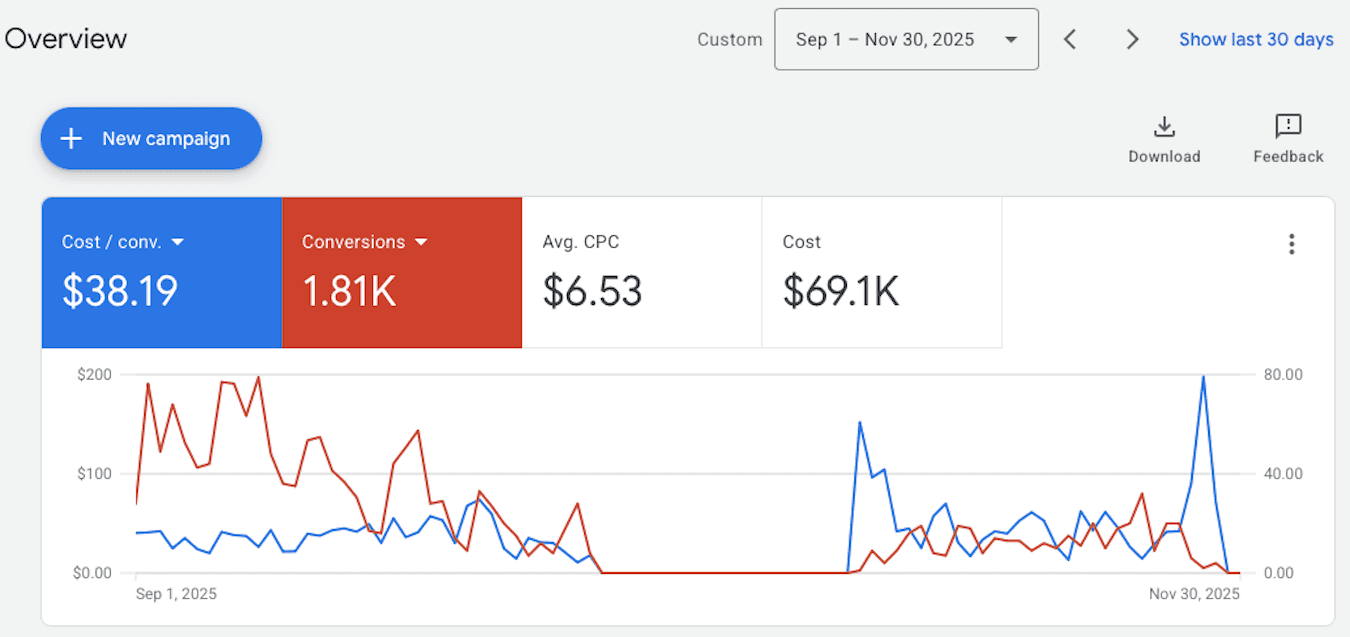
Before designing the new build, we audited what the firm had been operating under. On paper, the old ad account looked perfectly healthy. Strong "conversion" volume, low cost per conversion, all the green dashboards you'd expect.
The numbers were misleading.
The old account was counting nearly anything that moved as a conversion. Click-to-call taps were the largest single category, with over 1,400 of them across two separate tracking events in a 90-day window. So were "get directions" clicks. So were page views.
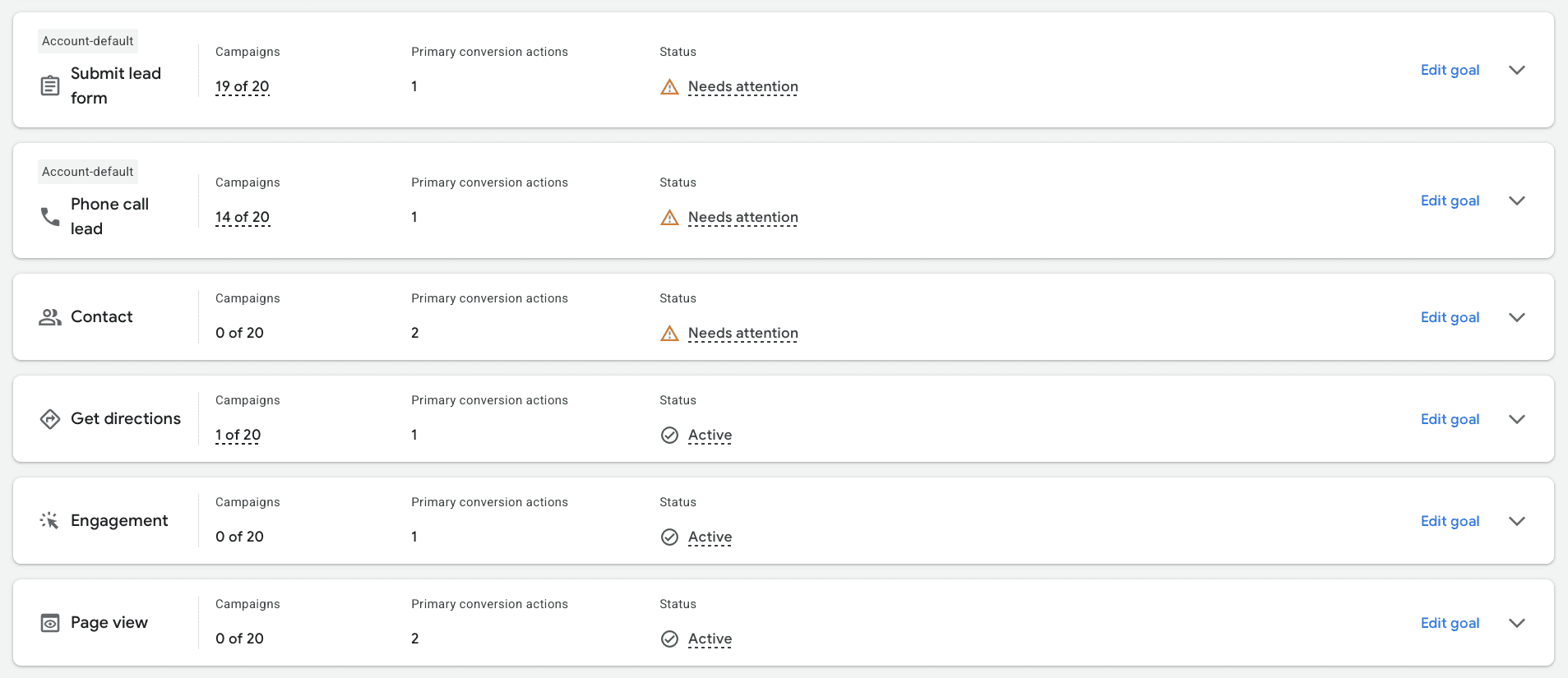
A click on a hyperlinked phone number isn't the same as a phone conversation. Industry call-tracking platforms confirm what Google's own documentation says: click-to-call events fire on the tap, regardless of what happens next. Calls under 30 seconds are dominated by misdials, hang-ups, voicemail bounces, and "is this you?" calls. That's why the industry-standard threshold for treating a call as a real conversion is 30 to 60 seconds, not zero.
When most of what's being counted as a "conversion" never produces a real conversation with intake, the bidding system feeding off that signal is being trained to find more of the same low-value behavior. The old account wasn't bad because anyone was incompetent. It was bad because the definition of a conversion was wrong, and every dollar of optimization was compounding that error.
This was the most important thing we found in the audit. Not a tactical mistake. A foundational one.
The Strategy: Rebuild on Real Signal, Then Scale on Top of It
We approached this engagement the way an engineer approaches a system rebuild. Foundation first, scale second.
The temptation in a forced-restart situation is to throw everything live as fast as possible. We did push hard on speed. The first new campaigns went live less than a month after engagement, on a brand-new account with no historical data. But we didn't compromise on getting the core architecture right.
Step 1: Redefine What Counts as a Lead
Before launching, we replaced the old conversion definitions with ones that would actually train Google's bidding system on quality:
Qualified phone calls (60+ seconds), tracked both through the call extension on Google Ads and from the website via Google Tag Manager
Form submissions, validated through the firm's intake system
Consultation requests completed end-to-end
The 60-second threshold reframes the entire account. Yes, the cost-per-lead number goes up. But each "lead" is now a real lead, and Google's algorithm starts chasing real qualified intent instead of phone-button taps.
Step 2: Build a Geo-Segmented, Purpose-Built Architecture
We launched the new account with a clean campaign hierarchy:
Layer | Role |
|---|---|
Brand | Defends search demand for the firm's name |
Non-Brand (Case Type) | Targets high-intent personal injury queries by case type |
Competitor Conquest | Captures intent from prospects searching for other firms |
Performance Max | Google's automated cross-network campaign type, fed only on clean conversion signal |
YouTube | Top-of-funnel demand creation, supplying audience signal back into the lower-funnel campaigns |
Every major metro got its own campaign envelope rather than a single national campaign. This matters more than people think. Cost per lead, lead quality, and competitive intensity differ enormously between metros. A blended national budget hides those differences and bleeds spend into the markets where it works least well. Segmenting them lets every market be optimized and budgeted on its own terms.
Step 3: Migrate to Smarter Bidding, on the Right Schedule
In month three, we migrated the major metro campaigns to Target CPA bidding. That's a mode where Google bids based on the actual likelihood that a click will produce a conversion, not just whether the click is cheap.
We deliberately didn't do this at launch. Smart bidding works on conversion data, and it needs accurate, sufficient data to bid well. Migrating before the data was clean and the volume was meaningful would've just locked in the wrong learnings.
By April, the statewide case-type campaign's cost per lead recovered from $425 in March to $299 in April. That's a 30% improvement in 30 days, and it's directly attributable to the bidding system finally having clean signal to operate on.
Step 4: Tight Search-Term Discipline
Personal injury attracts a huge volume of searches that look like PI queries but aren't. Civil lawsuits, free legal advice, workers' comp questions, class actions, state bar lookups, medical malpractice. Without active filtering, all of those siphon spend.
We've kept up an aggressive cadence of negative keyword work across the entire engagement. By April, the impact was clear: ad click-through rate climbed from 3.25% to 3.95%, and we identified $2,500 to $4,000 a month in spend the negative-keyword work was clawing back from junk traffic.
When the System Got Tested
A five-month rebuild-and-scale doesn't go in a straight line. We ran into a series of platform-side and external technical issues that any growth-stage account eventually hits. Compliance flags, brief platform-level disruptions, third-party tracking quirks. Each one was a near-miss on pacing.
Honestly, this is the strongest part of the case study, not a weakness. A multi-month engagement at this spend level without a single hiccup isn't realistic. What separates agencies is whether they can recover from the inevitable disruptions without losing pacing. We can. None of those disruptions showed up in the firm's monthly lead numbers.
The Results: 5 Months In
Firm-Wide Performance, January to April 2026
Metric | Jan 2026 | Feb 2026 | Mar 2026 | Apr 2026 |
|---|---|---|---|---|
Total leads | 725 | 774 | 1,063 | 1,123 |
Qualified leads | 370 | 340 | 481 | 464 |
Signed cases | 341 | 309 | 442 | 424 |
Qualified-to-signed rate | 92.2% | 90.9% | 91.9% | 91.4% |
Two numbers in this table do most of the work.
Total firm leads grew from 725 in January to 1,123 in April. That's a 54.9% increase in four months. April produced the highest single-month firm-wide lead count we've measured for this firm, beating even the pre-engagement peaks. Volume isn't the whole story, but it's the foundation everything else rests on.
The qualified-to-signed-case rate held steady at ~91% across the entire scale-up. That's the cleanest signal we have that we're feeding the firm real, workable leads, not volume for volume's sake. Holding a 91% qualified-to-signed rate while ad spend goes up 6x isn't a normal outcome in this category.
A note on the variables we don't control. Total firm performance is influenced by a lot of moving parts that have nothing to do with paid search: the firm's other lead channels (referrals, billboards, TV, sponsorships), seasonal swings in personal injury claim volume, intake capacity, and ongoing operational changes inside the firm during the transition. The case-volume trend has held remarkably steady through all of that, and the scaling we've done on the ad side has been the largest controllable contributor.
Direct Ad Performance
Metric | February | March | April |
|---|---|---|---|
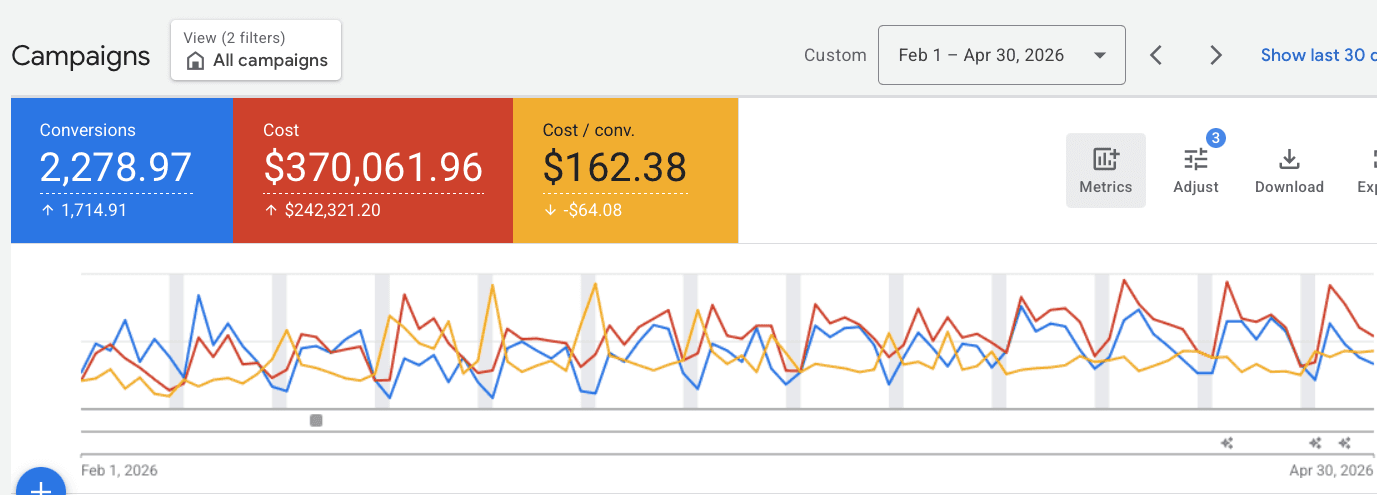
Ad spend | $92,489 | $131,940 | $149,485 |
Directly attributed ad leads | 663 | 750 | 867 |
Cost per lead (direct) | $139 | $176 | $172 |
The Three Numbers That Matter Most
~6x scale in monthly ad spend, with no drop in the qualification standard. The previous setup had been operating around $23,000 a month. By April, we were running $149,000 a month. And 6 of 10 active lead-gen campaigns were still capped by budget, not by competitive ceiling. There's more room above where we are than below it.
~91% qualified-to-signed rate, holding flat. More than nine in ten qualified leads turn into signed cases. That number has stayed flat through the entire scale-up.
Estimated $10M to $16.7M in projected case revenue from April's ad spend. At the firm's lead-to-sign rate and case-value range, the leads produced by April's $149,485 in ad spend project to between $10 million and $16.7 million in case revenue. That's a return-on-ad-spend range that speaks for itself.
Where the Firm Was vs. Where the Firm Is
Pre-Engagement (Sept to Nov 2025) | Current (April 2026) | |
|---|---|---|
Monthly ad spend | ~$23,000 | $149,485 |
Conversion definition | Phone-button taps, page views, get-directions clicks counted as primary conversions | 60-second qualified calls + validated form submissions only |
Tracking infrastructure | Inherited, opaque, double-counting in places | Rebuilt from scratch with clear attribution |
Active campaign architecture | Performance Max-heavy, single-market construction | Geo-segmented multi-market with brand / non-brand / competitor separation |
A direct cost-per-lead comparison between the two periods isn't apples-to-apples. We'd rather call that out honestly than spin a misleading "X% reduction" headline. The previous account's $38 cost-per-conversion was a real number, but most of those "conversions" weren't qualified leads. Today's $172 cost-per-lead is also a real number, and every one of those leads is something the firm's intake team can actually work.
Why This Worked: The House of Growth Methodology
The conversion definition is the most important decision in the account. Everything downstream from it (bidding, budget allocation, audience expansion, creative testing) runs on top of what the system thinks counts as success. Get the definition wrong and every later optimization makes the problem worse. Get it right and the rest of the work compounds.
Speed and discipline aren't opposites. The firm needed to be live fast. We launched on a brand-new account with no historical data less than a month after engagement. But we held the line on conversion-definition rigor and bidding-system migration timing. We didn't let the speed pressure force shortcuts that would've cost us scale later.
Multi-market firms need multi-market architecture. Treating four metros as one campaign is the single most common structural mistake we see in PI accounts at this scale. Campaign-level segmentation by metro and intent layer is what makes it possible to fund the markets that are working, see the ones that need attention, and respond to local competitive shifts in days, not months.
Hurdles will happen. Plan for the recovery. A multi-month engagement at this spend level without a single platform issue or compliance hiccup isn't realistic. What separates agencies is muscle memory in the recovery.
Headroom is the real KPI. A campaign hitting target metrics but already maxed-out is a campaign about to plateau. The strongest signal in this account today isn't any single performance number. It's that 6 of 10 lead-gen campaigns are budget-capped, not competition-capped. There's room above the current performance. And we have a queue of additional channels we haven't even launched yet: Microsoft Search Ads, Google Local Services Ads, programmatic display, geo-targeted display.
Ready to Build a System That Scales?
If your firm's paid acquisition has plateaued, looks great on paper but isn't translating to signed cases, or is heading into a transition that's going to require rebuilding from the ground up, this is the kind of work we do.